Takeda, Mitsubishi Logistics and JR Freight Introduce Japan’s First 31 Foot Temperature Controlled Containers for Pharmaceutical Transportation– Increased transport capacity and expanded service areas accelerate modal shift to rail –
Feb. 05, 2026

- Takeda, Mitsubishi Logistics and JR Freight have begun transporting pharmaceuticals using 31‑foot temperature‑controlled rail containers—larger than the standard 12‑foot temperature‑controlled containers typically used in Japan’s rail network—to further reduce greenhouse gas emissions and help address the country’s 2024 logistics challenges.
- The 31‑foot temperature‑controlled containers enable GDP‑compliant transportation while expanding capacity and geographic coverage. With this introduction, approximately 60% (by weight) of the target areas for rail conversion in pharmaceutical logistics have now shifted from road to rail, achieving an estimated 58% reduction in greenhouse gas emissions on converted routes.
- The three companies will continue expanding the use of rail transport to further minimize their environmental impact.
Osaka and Tokyo, Japan, February 5, 2025 - Takeda Pharmaceutical Company Limited (TSE: 4502/NYSE: TAK; Headquarters: Chuo‑ku, Osaka; President & CEO: Christophe Weber; hereinafter “Takeda”), Mitsubishi Logistics Corporation (Headquarters: Chuo‑ku, Tokyo; Representative Director and President: Hidechika Saito; hereinafter “Mitsubishi Logistics”) and Japan Freight Railway Company (Headquarters: Minato‑ku, Tokyo; President: Shin Inukai; hereinafter “JR Freight”) today announced the introduction of 31‑foot temperature‑controlled rail containers for the transport of Takeda’s pharmaceuticals. The initiative aims to further reduce greenhouse gas emissions from transportation and expand the scope of Takeda’s modal shift from truck to rail.
31‑Foot temperature‑controlled Container Introduction: Background
In recent years, Japan’s logistics sector has been facing several pressing challenges:
- Need to reduce environmental impact: Reducing greenhouse gas emissions is an urgent priority in supporting the transition to a net-zero society.
- Response to the 2024 Logistics Problem: Stricter regulations on truck drivers’ working hours are raising concerns about declining trucking capacity.
- Strengthening supply chain resilience: Multiple transportation modes are increasingly important in preparation for natural disasters and emergencies.
In response, Takeda, Mitsubishi Logistics and JR Freight began exploring rail‑based pharmaceutical transportation since 2023.
Until now, the companies have used 12‑foot temperature‑controlled containers—the primary size used for domestic rail freight in Japan—but determined that larger 31‑foot temperature‑controlled containers would be a more efficient solution for scaling up volume.
Although 31‑foot temperature‑controlled containers have a track record in transporting agricultural products, industrial goods and consolidated cargo, they are scarce in the Japanese market. To ensure stable use, they must be operated on a dedicated basis, which had previously prevented their introduction for pharmaceutical transportation.
Because 31‑foot temperature‑controlled containers offer nearly the same internal capacity as a 10‑ton truck, they enable modal shift without requiring major changes to loading configurations or handling operations. After validating route compatibility and temperature performance within the containers, the three companies concluded that GDP‑compliant transportation is feasible and decided to introduce the 31‑foot units.
Progress of the Modal Shift to Rail
As part of Takeda’s commitment to net-zero greenhouse gas emissions across its value chain by 2040 Takeda explored transportation modes that have a lower carbon footprint.
In 2023, Takeda began shifting long distance trunk transportation of pharmaceuticals to rail, starting with the Tohoku region, and expanded to Kyushu, Shikoku, Hokuriku and Joetsu from December 2024 through July 2025.
With the introduction of the 31‑foot temperature‑controlled containers, Takeda further expanded rail transportation in Kyushu in December 2025 and in Tohoku in January 2026. As a result, approximately 60% of the target areas (by transport weight) have already transitioned to rail.
By shifting the trunk portion of transport from road to rail while continuing to use trucks only for the first and last mile, greenhouse gas emissions on applicable routes are expected to decrease by approximately 58%1. Having two established trunk modes—rail and truck—also strengthens supply chain resilience by ensuring that high‑quality pharmaceuticals can continue to be delivered even if one mode is disrupted. The reduction in long‑distance truck transport also contributes significantly to addressing Japan’s 2024 Logistics Problem2.
Furthermore, Takeda continues to use ML Chain, the digital data platform developed by Mitsubishi Logistics and introduced already in in January 2022,, to visualize temperature and location data across the distribution process. The platform’s smart contract capabilities also allow Takeda to verify licenses, approvals and audit records for external logistics partners engaged by Mitsubishi Logistics.
Yukihiro Matsumoto, Head of Global Manufacturing & Supply Japan at Takeda, said, “This initiative is the result of strong collaboration among Mitsubishi Logistics, JR Freight and Takeda, each leveraging its own strengths. As part of our net-zero ambition, we will continue encouraging the development of joint‑delivery frameworks involving multiple manufacturers to improve logistics efficiency, reduce environmental impact and maximize total cost benefits. By utilizing rail for long‑distance trunk transport and optimizing pre‑ and post‑haul processes, we aim to accelerate an industrywide transition to a more sustainable pharmaceutical logistics model that enhances both environmental performance and supply chain resilience.”
Eiichi Kato, Managing Executive Officer at Mitsubishi Logistics, said, “Our group is reinforcing its climate and environmental initiatives as part of its commitment to a sustainable society. We offer support in every aspect of storage, cargo handling, and transportation throughout our customers’ global supply chains. We are very pleased that the introduction of the 31‑foot temperature‑controlled containers has made a significant contribution to the modal shift in pharmaceutical logistics. Looking ahead, we aim to establish a shared‑delivery framework involving multiple manufacturers and advance a more sustainable logistics model for pharmaceuticals.”
Yasuhide Mugiya, Executive Officer and General Manager of the Sales Department, Railway Business Headquarters, at JR Freight, said, “We are grateful for the introduction of the 31‑foot temperature‑controlled containers and for the continued promotion of the modal shift to rail. We are honored that freight rail transport can contribute to building a more sustainable logistics model for pharmaceuticals. Through this initiative, we will continue our efforts to support the development of an environmentally friendly and resilient pharmaceutical supply chain in Japan.”
Takeda is committed to creating long‑term value for patients, the people we work with and the planet that sustains life. As part of this commitment, the company continues to work with suppliers to reduce Scope 3 greenhouse gas emissions. Mitsubishi Logistics is strengthening its climate and environmental measures as part of its sustainability‑focused management, while JR Freight contributes to greenhouse gas reduction by providing environmentally friendly freight rail services.
Takeda, Mitsubishi Logistics and JR Freight will continue expanding the use of rail— including shifting the trunk portion of transportation from Tokyo to Hokkaido—to further reduce environmental impact.
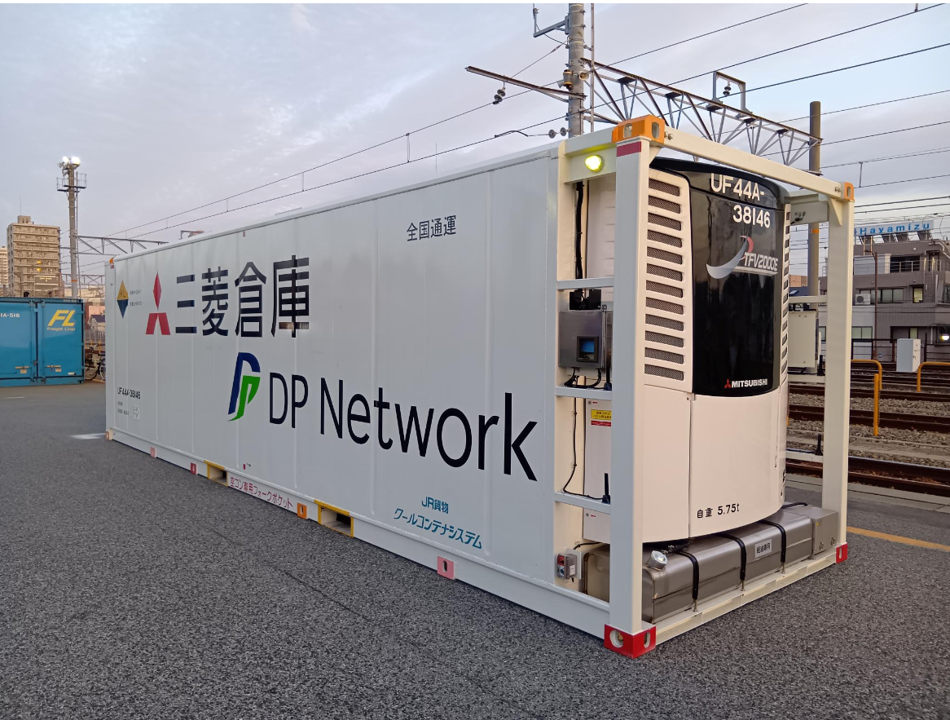
Since December 2025, Takeda has been using 31‑ft temperature‑controlled dedicated railway containers for pharmaceutical transportation.
*1 Calculated by Mitsubishi Logistics and JR Freight based on the “Guidelines for Calculating CO2 Emissions in the Logistics Sector” jointly issued by the Ministry of Economy, Trade and Industry and the Ministry of Land, Infrastructure, Transport and Tourism.
*2 Reference: Ministry of Land, Infrastructure, Transport and Tourism, “The 2024 Logistics Problem.”
https://www.mlit.go.jp/policy/shingikai/content/001620626.pdf
About Takeda
Takeda is focused on creating better health for people and a brighter future for the world. We aim to discover and deliver life-transforming treatments in our core therapeutic and business areas, including gastrointestinal and inflammation, rare diseases, plasma-derived therapies, oncology, neuroscience and vaccines. Together with our partners, we aim to improve the patient experience and advance a new frontier of treatment options through our dynamic and diverse pipeline. As a leading values-based, R&D-driven biopharmaceutical company headquartered in Japan, we are guided by our commitment to patients, our people and the planet. Our employees in approximately 80 countries and regions are driven by our purpose and are grounded in the values that have defined us for more than two centuries. For more information, visit www.takeda.com/jp.
About Mitsubishi Logistics
Mitsubishi Logistics operates globally in two main businesses: logistics and real estate. In the logistics business, we provide comprehensive logistics services including warehousing, land transportation, international ocean and air transportation, as well as port and harbor transportation. In the real estate business, we develop, lease, and manage a variety of facilities such as office buildings, commercial facilities, and condominiums. In the pharmaceutical logistics area, we provide high-quality logistics services by leveraging the know-how we have amassed over 40 years of operating distribution centers for several pharmaceutical manufacturers. For more information, please visit https://www.mitsubishi-logistics.co.jp/.
About JR Freight
Japan Freight Railway Company transports freight by rail utilizing its nationwide rail network. Freight rail makes it possible to move large volumes of goods in a highly environmentally friendly way, especially for medium- to long-distance transport. JR Freight will continue to promote its comprehensive logistics business based on its rail network, providing customers with optimal one-stop logistics solutions. For more information, please visit https://www.jrfreight.co.jp/
Media Contact:
Global Manufacturing & Supply Communications
Takeda Pharmaceutical Company, Limited
080-5789-7742
Mitsubishi Logistics
Corporate Communications & Investor Relations Div.
03-3278-6652
Japan Freight Railway Company
Public Relations Office, Administration Department
050-2017-4088